
How the MSRA is Marked
What MSRA Scoring and Score Distributions reveal about its fairness

Most people have an idea that the MSRA score is a standardised form of your raw mark. But what is actually happening, and what does the process reveal about the fairness of the MSRA? Let's dive deep into this topic.
How the Professional Dilemma paper is scored
The Professional Dilemma paper consists of 2 types of questions: Ranking and Multiple-Choice. Both of which are scored differently.
Multiple-Choice Question (MCQ) Scoring
Scoring the MCQs is pretty straight forward, you receive 4 marks for each correct answer. As there are usually 3 correct answers for each question the maximum score is 12. There is no negative marking so any incorrect answers simply score a 0.
MCQ Scoring Demo
Select three options
Your score
0
Correct Answer
Wrong Answer
Wrong Answer
Correct Answer
Correct Answer
Wrong Answer
Wrong Answer
Ranking Question Scoring
Ranking questions are different in that they provide marks for near misses. In ranking questions you will typically be given 4-5 options to rank. If you place the option in the correct rank you will get 4 marks, if you place the option either one slot above or below its true rank then you will still score 3 marks. Two slots away scores you 2 marks and so on. There is no negative marking.
When added up this gives you a maximum score of 20 per ranking question and a minimum score of 8.
Ranking Question Scoring Demo
Rank these 5 options
Your score
0
Correct Rank
+/- 1 From Correct Rank
+/- 2 From Correct Rank
> 3 From Correct Rank
What is the maximum score on the Professional Dilemma paper?
The Professional Dilemma paper has a maximum score of around ~640, this will vary depending on the mix between ranking and multiple-choice questions and the number of pilot questions (which are not included in your score).
How the Clinical Problem Solving paper is scored
The Clinical Problem Solving paper consists of 2 question types: Extended Matching (EM) and Single Best Answer (SBA).
Extended Matching Question Scoring
Extended Matching Questions comprise of clinical scenarios which share the same 7 to 10 plausible answers. Each question will have just one correct answer for which you score one mark. There is no negative marking, a wrong answer simply scores 0.
Single Best Answer Scoring
Single Best Answer Questions comprise of a single clinical scenarios with 5-8 plausible answers. Each question will have just one correct answer for which you score one mark. There is no negative marking, a wrong answer simply scores 0.
What is the maximum score on the Clinical Problem Solving Paper?
The Clinical Problem Solving (CPS) Paper will have a maximum score of around ~86. This varies slightly between CPS papers depending on the number of pilot questions (which are not marked) included.
Standardisation
At the end of the test you will have two raw scores, one for the Professional Dilemmas (PD) paper and one for the Clinical Problem Solving (CPS) paper.
So why does the score need to go through a transformation process, why aren't you simply ranked based on your raw score?
Why Standardise?
There are actually many good reasons for standardising the score:
- The CPS paper will typically have a maximum score of ~86, whereas the PD paper will have a maximum score of around ~640. This is as PD questions have a maximum score of 8-20, whereas CPS questions will have a maximum score of just 1. Standardising these scores helps giving them equal weighting.
- Not everyone sits the same MSRA paper, even within the same MSRA window. In fact there are typically about 8 different papers, this is to help stop people sharing questions and giving later exam takers an unfair advantage. These papers can have a subtle difference in difficulty which can result in people performing worse on one MSRA paper compared with another. Standardisation attempts to correct for this so people don't get unfairly penalised for sitting a harder paper.
- It allows for comparison of performance across papers taken in different years.
How Standardisation Is Done
Standardisation itself is a simple process and is done separately for each paper.
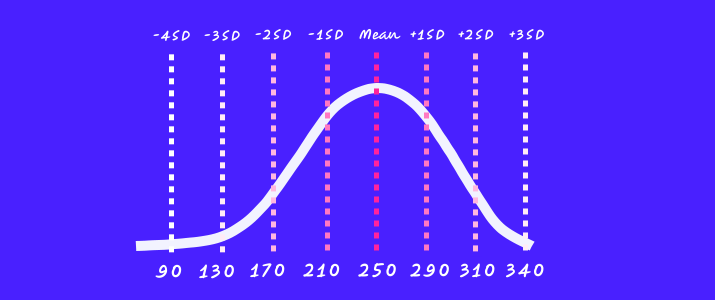
The average (mean) raw score is calculated across everyone that sat the paper, this is normally around ~79% for the PD paper and ~69% for the CPS paper. Candidates with the mean score are given a new standardised score of 250.
Scores are then allocated based on how many standard deviations your performance is from the mean, with +40 standardised points given for every 1 SD above the mean and -40 for every SD below the mean.
This is what your score represents, how many standard deviations your performance was from the mean.
The distribution of scores is very left skewed, especially for the Professional Dilemmas paper. This means that most candidates do reasonably well and will score close together with a long tail of candidates who score much more poorly.
Because of this candidates who score low, but maybe reasonable scores, will get a catastrophically low standardised score. For example if you get 60% of the full marks on the Professional Dilemma paper your standardised score will be 101.
This standardisation process is completed separately for both papers. You will receive a standardised score for each paper and one combined score that adds them both together with equal weighting.
Standardisation is done across all MSRA takers, not on a speciality-by-speciality basis. As such your MSRA score will be the same for each speciality training programme that you have applied for within the same recruitment round.
Professional Dilemma score distribution
Explore how your raw score is converted into a standardised score.
Data derived from 2024 MSRA results provided by NHS England
Candidates tend to score very closely together on the Professional Dilemma paper, as such 1 SD is normally around ~5% from the mean.
This causes an extraordinary effect where the difference between a candidate being in the top 10% of all candidates (standardised score of 300) or being average (250) is 6 percentage marks. This is the equivalent of 36 raw marks, or getting full marks on 3 MCQ questions.
This shows two important things:
- You really need to answer every question. Running out of time and missing just 3 questions can take you from getting into any training programme, to getting into just the least competitive. Luckily timing is rarely an issue, official MSRA data shows that 98-99% of candidates will answer every question.
- Anything you can do to elevate your performance above the average will have massive incremental gains.
Clinical Problem Solving distribution
Explore how your raw score is converted into a standardised score.
Data derived from 2024 MSRA results provided by NHS England
Scores are more widely distributed for the Clinical Problem Solving paper so 1 SD is typically ~11% from the mean.
Improving your standardised score required a much bigger improvement in performance. To go from an average score (250) to the top 10% of candidates (300) requires an improvement of 18 percentage marks (from 68% to 86%).
Fairness
A fair exam is one that truly measures the domain(s) that it is assessing for, with minimal error.
For example if the Clinical Problem Solving paper were to be considered fair then it must consistently score candidates with better clinical knowledge above those with average clinical knowledge.
Now no exam is ever perfectly fair for various reasons that are hard to resolve, such as:
- Exams can only ask a limited set of questions. In a general exam it is hard for a small set to adequately represent all the possible topics that are within the knowledge space. As such the exam is likely to be biased towards candidates who are more knowledgeable in the specific topics that get asked about and away from candidates who are stronger in other topics which did not come up purely due to chance.
- There may be reasonable disagreement about the correct answer, such that two strong candidates may reasonably select different answers. This is particularly true for the Professional Dilemma paper.
- There may be ambiguity in the wording of a question.
We call these issues errors.
Exam boards are well aware of this and routinely measure the effect these errors have on candidates scores using a statistical approach called the Standard Error of Measurement (SEM).
Standard Error of Measurement (SEM)
The SEM tells us where a candidates true score is likely to lie if any error were to be removed from the exam. It cannot tell us precisely what a candidate should have scored, or even if they were helped or hindered by error.
Another way to think of this is as follows: If we have 100 people sitting an exam and compared their scores, a perfect exam would rank the 60th most knowledgeable candidate 60th each time. In the real world, where exams have biases and errors, the exam may sometimes rank this candidate as the 50th best, or the 70th best depending on the variation of the exam sat. This range of possible values is the Standard Error of Measurement.
The better an exam is, the smaller its SEM should be.
The SEM of the Professional Dilemma paper
The SEM of the Professional Dilemma paper is typically around 14 to 15 raw marks.
This is quite small in the context of the overall marks available, representing about 2.2% of all the marks available.
Because most candidates score very closely together however, this error ends up having a much larger effect on your standardised score. This is the random number machine aspect of the Professional Dilemma paper in action. You can see the effect this has in the chart below.
Professional Dilemma score distribution with SEM included
Explore how randomness within the exam can effect your score.
Data derived from 2024 MSRA results provided by NHS England
A candidate scoring 282 in the Professional Dilemma paper may reasonably had scored between 265 and 299 depending on the variation of the paper they sat.
This effect size is huge and right now affects the trajectory of peoples lives and careers. It can make the difference between getting into your dream programme in your dream location to not even getting into your back-up programme. All based on randomness.
All hope is not lost though, by improving your average performance you also shift up your error and at the extreme ends of performance error has a smaller impact on your score.
Nontheless we believe that fundamentally the Professional Dilemma paper, in its current state, has too much error and makes for a poor tool in ranking candidates.
Join the waitlist for the Early Access Programme. Places limited.
Our free Early Access Programme opens on 1st May 2026